

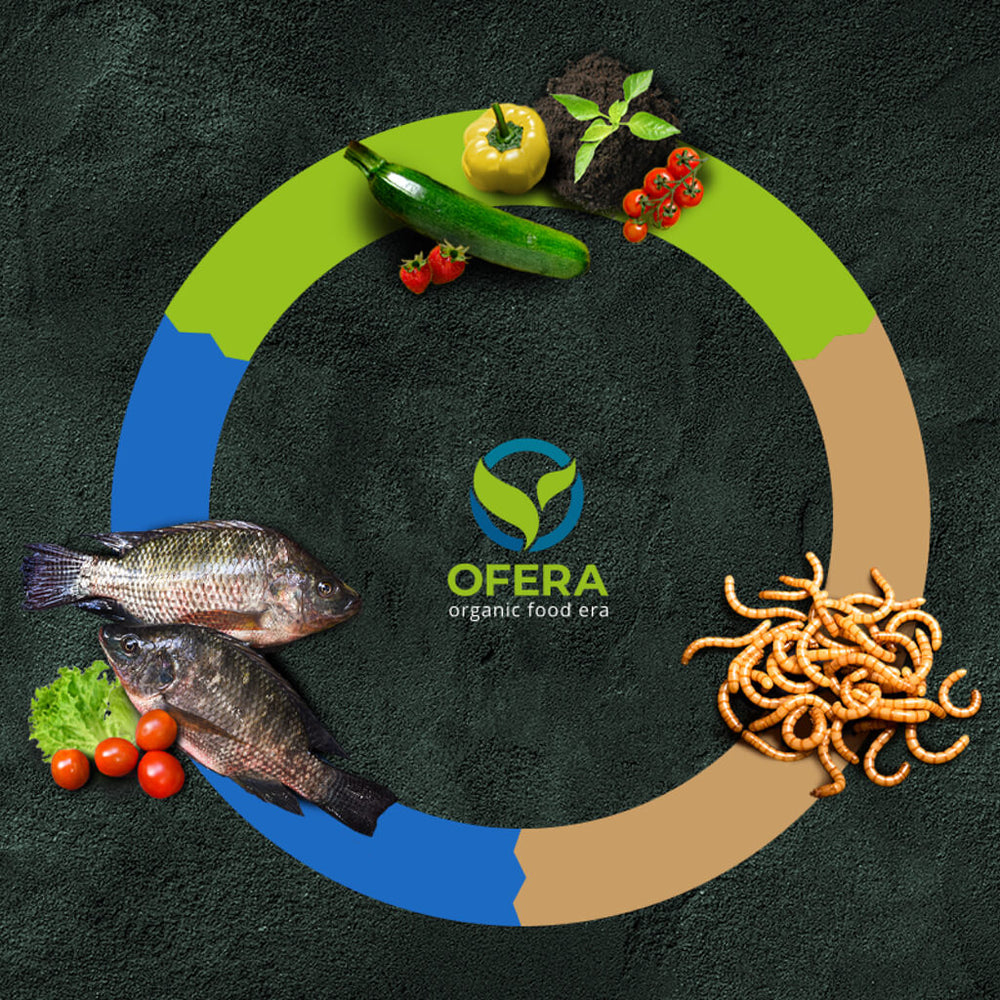

Rising feed prices are putting increasing pressure on animal keepers. At the same time, the demand for natural and sustainable animal feed is growing. But this is exactly where the problem lies: many industrial feeds are declining in quality or contain additives that people would rather avoid.
A surprisingly simple solution comes from the insect world: the Black Soldier Fly. With a Black Soldier Fly Breeding Box, nutrient-rich Black Soldier Fly Larvae (BSFL) can be produced from simple food waste – creating a natural cycle of waste recycling and feed production.
In this article, you will learn how black soldier fly larvae can help you reduce feed costs, what to consider when buying or building your own BSF breeding box, and how to produce high-quality protein feed from food scraps.
- What exactly are black soldier fly larvae?
- Where the black soldier fly occurs
- Why raise black soldier fly larvae?
- What exactly is a black soldier fly breeding box?
- Buy a black soldier fly breeding box or build one yourself?
- Understanding different black soldier fly breeding systems
- Common mistakes when building and operating a black soldier fly breeding box
- Conclusion
- Build your own black soldier fly breeding box with OFERA
With your own breeding box, black soldier fly larvae can be raised from kitchen scraps and organic waste – a natural cycle that combines waste recycling with animal feed production.
The larvae of the black soldier fly (Hermetia illucens) are among the most efficient organisms for processing organic waste. Within a short time, they convert vegetable and fruit scraps into nutrient-rich biomass that can be used as excellent animal feed.

Especially for keepers of chickens, birds, fish, and reptiles, raising black soldier fly larvae can be an interesting way to provide animals with a more natural and protein-rich diet while also recycling food waste in a meaningful way.
What exactly are black soldier fly larvae?
Black soldier fly larvae (BSFL) are the larval stage of the black soldier fly (Hermetia illucens). They are well known for their ability to process organic waste extremely efficiently. The adult fly itself plays a rather indirect role in feed production – the real value lies in the larvae.

During their growth phase, the larvae feed almost continuously on organic material. In the process, the substrate is not only decomposed but actively converted into valuable biomass. This is why the species is considered particularly efficient when it comes to biological waste conversion.
Typical characteristics of the larvae include:
• extremely fast development
• high protein and fat content
• efficient conversion of organic waste
• a strong migration behavior before pupation
This migration behavior is one of the reasons why a well-designed black soldier fly breeding box works so elegantly. Shortly before pupation, the larvae instinctively leave the substrate and search for a dry place. In a properly designed BSF breeding box, this behavior can be used intentionally: an integrated ramp guides the larvae directly into a collection container – meaning the harvest practically happens by itself.

If you want to learn more about the life cycle of the black soldier fly, we recommend this blog article. There you can learn more about the life cycle of the black soldier fly – from egg to adult fly.
Where the black soldier fly occurs
The black soldier fly originates from tropical and subtropical regions of the Americas. Its origin is believed to be in South America, from where it spread to many other parts of the world through trade and transportation routes.
Today, the species can be found in many warm regions. In Europe it was first documented in 1926 on Malta and later spread mainly throughout the Mediterranean region.
In Central Europe and other temperate climates, its natural presence depends strongly on climate conditions. In many regions of the world, stable populations occur only during warm months or in tropical climates.
Anyone who wants to raise black soldier fly larvae year-round often relies on controlled systems. In such systems, both the flies and the larvae are kept under stable environmental conditions, making continuous production independent of climate possible.
Why raise black soldier fly larvae?
Raising black soldier fly larvae is particularly interesting because it combines two processes that usually happen separately: waste recycling and feed production.
Organic waste is not simply discarded but converted by the larvae into valuable biomass. This creates a circular system that is both ecologically and economically beneficial.
But that’s not all: during the processing of organic waste, the larvae leave behind a valuable residue known as frass. This material, produced during the composting process, can be used as an excellent natural fertilizer for vegetables, garden plants, and houseplants.
For animal keepers, this offers several advantages:
- part of the animal feed can be produced at home
- the quality of the feed remains controllable
- industrial feeds can be partially replaced
- food waste can be recycled effectively
- high-quality organic fertilizer can be used in gardens and for indoor plants
Especially in small-scale animal keeping or self-sufficient systems, a compact black soldier fly breeding box can therefore be a very practical addition.


What exactly is a black soldier fly breeding box?
At first glance, a black soldier fly breeding box often looks similar to a simple compost bin. In fact, the breeding process is based on a similar principle: organic material is biologically processed.
However, the key difference lies in several structural details. While a classic compost bin mainly focuses on decomposition, a BSF breeding box is designed to produce as many larvae as possible and harvest them efficiently.
A functional breeding box must accomplish several things at once:
- provide sufficient aeration of the substrate
- dissipate heat generated during composting
- regulate excess moisture
- give the larvae enough space to develop
- ideally enable automatic harvesting
The so-called self-harvesting system is one of the characteristic features of many black soldier fly breeding boxes. These requirements make the construction of a well-designed system crucial for stable and productive BSF larvae farming.

Buy a black soldier fly breeding box or build one yourself?
When exploring black soldier fly larvae farming, you quickly encounter two main options – and therefore a fundamental decision: buy a ready-made breeding box or build your own BSF bin.
Both options have advantages and disadvantages. Ready-made systems can make the beginning easier and are often professionally designed, but they are usually more expensive.
Many beginners intentionally choose the DIY approach because it provides a better understanding of the breeding process – and this experience can be extremely valuable.
During the building process, you quickly learn which factors are crucial for successfully raising black soldier fly larvae:
- correct container size
- suitable substrate depth
- proper ventilation
- effective moisture management
Understanding different black soldier fly breeding systems
In practice, several BSF breeding box designs have emerged. They mainly differ in how strongly the life cycle of the black soldier fly is controlled.
1. Breeding boxes for larval rearing only
The simplest system is a box used only for larval rearing.
In this setup, only the larvae are kept and fed. This requires either a natural supply of black soldier fly eggs or regular deliveries of eggs or young larvae from other breeders – which can become logistically inconvenient over time.

Systems with natural egg deposition work particularly well in regions where black soldier flies already occur naturally. There, flies often lay eggs reliably in dedicated structures such as fly hives, usually mounted in the lid area of the breeding box.
From these eggs, the young larvae hatch and grow within the substrate until they reach their final larval stage.
2. Systems with a separate fly habitat
To achieve more stable production, many breeders separate two areas:
In so-called love cages, adult flies are kept and encouraged to mate. The females lay their eggs in fly hives – usually small crevice structures made of cardboard or wooden slats that mimic natural egg-laying sites.
The eggs are then collected and often incubated in smaller, controlled containers until they hatch. During the first days, the newly hatched larvae are fed finely processed feed before being transferred into the larval rearing box.
The advantage of this system lies in better control over the entire life cycle of the black soldier fly and a predictable, continuous production cycle.
3. All-in-one breeding box
A third approach combines both systems into a single setup – often without requiring high initial investment.
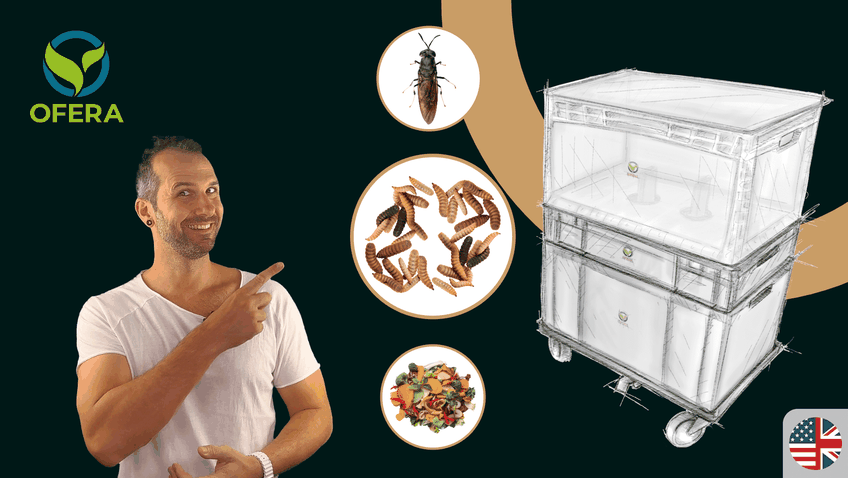
An all-in-one black soldier fly breeding box integrates
- fly habitat
- egg-laying area
- larval rearing
- automatic self-harvesting
within one system. For beginners in particular, such a solution can be very attractive because it represents the entire black soldier fly life cycle within one construction.
- Detailed video course
- Step-by-step instructions
- Simple explanations for DIY construction
- Everything from PLUS
- + CAD files & drawings
- + BONUS chapter: Practical breeding tips & tricks
Common mistakes when building and operating a black soldier fly breeding box
Many problems do not arise from complicated technology but from small design details. For example, the harvesting ramp may be incorrectly sized or too steep, or the material and surface texture may not allow the larvae to climb properly. The material and properties of the container, as well as integrated drainage and ventilation systems, also play an important role.
During construction
Here are some typical mistakes and tips to avoid when building your system:
- Use plastic containers or well-treated durable wood
- For plastic containers, ensure they are food-safe
- Ensure adequate ventilation, airflow and heat circulation
- Prevent waterlogging with a proper drainage system
During operation
During operation, a substrate layer that is too deep is a common mistake. If too much material is placed in the container, areas with oxygen deficiency can develop inside – so-called anaerobic zones.
The biological conversion process performed by black soldier fly larvae works primarily aerobically, meaning it requires oxygen. Without sufficient oxygen, anaerobic zones can develop.
Typical consequences include:
- strong unpleasant odors
- excessive heat buildup
- escape behavior of the larvae
- or in the worst case, larval mortality
Conclusion
A black soldier fly breeding box makes it possible to turn simple food waste into high-quality protein feed. With some planning and the right materials, a functional BSF breeding box can be built relatively easily.
Those who explore black soldier fly larvae farming more deeply can not only reduce feed costs, but also contribute to a more sustainable circular economy.
Build your own black soldier fly breeding box with OFERA
If you want to build your own black soldier fly breeding box, avoid common beginner mistakes, and save a lot of time during planning and construction, our DIY course provides a detailed step-by-step guide with many valuable tips for getting started with raising black soldier fly larvae.
The course includes construction plans, material recommendations, and practical insights from real breeding experience to help you successfully build and operate your own system.
Build your own black soldier fly breeding box and get started
We also offer a DIY video course and step-by-step tutorial to help you build your own black soldier fly larvae breeding box.



Leave a comment